EducationSoftwareStrategy.com
StrategyCommunity

Knowledge Base

Product

Community

Knowledge Base

TopicsBrowse ArticlesDeveloper Zone

Product

Download SoftwareProduct DocumentationSecurity Hub

Education

Tutorial VideosSolution GalleryEducation courses

Community

GuidelinesGrandmastersEvents
x_social-icon_white.svglinkedin_social-icon_white.svg
Strategy logoCommunity

© Strategy Inc. All Rights Reserved.

LegalTerms of UsePrivacy Policy
  1. Home
  2. Topics

10.512: Advanced SDK for Customizing Branding


Stefan Zepeda

Salesforce Solutions Architect • Strategy


Learn how to create your own URL for custom navigation using the URL API. Create a page, a series of pages, your own prompt type, and a custom object, among other customization skills you will gain in this class. Design custom logic such as workflows. Learn how to customize services to achieve organizational efficiency and communication goals. Use beans, tasks, and events to modify the core behavior of MicroStrategy Web.

The following is a list of requirements and considerations when creating a dynamic subscription service:
 
Data Warehouse side

  • For information about data types, formats, and restrictions, refer to the following Strategy Knowledge Base document:
    • KB10469 - What are the data types and formats of subscription information for dynamic subscription sets?
  • Each subscription ID must uniquely identify a row in the subscription table.
  • There must a many-to-one relationship between the column storing subscription IDs and the remaining columns in the subscription table.
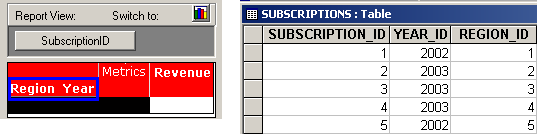
  • For Personalized Page Execution, the subscription table must have one column for each slicing attribute. For example, the subscription table below supports services whose content reports are sliced by attributes Year or Region; therefore, subscription_ID 1 receives pages corresponding to Year 2002 and Region 1:
ka04W000000Oe1EQAS_0EM440000002BoL.gif
  • If subscription information is to be retrieved from a combination of the data warehouse and Subscription Book Repository, then subscription IDs in the subscription table and in the Subscription Book Repository must be synchronized. Service designers can configure services so that when Subscription Portal users subscribe to those services, Strategy Narrowcast saves the subscription IDs along with other subscription information in the subscription table.

 
Intelligence Server side
There are two methods for retrieving dynamic subscription information from an external source: use the definition of the information source object, or run a subscription report:
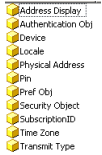
  • Definition of information source
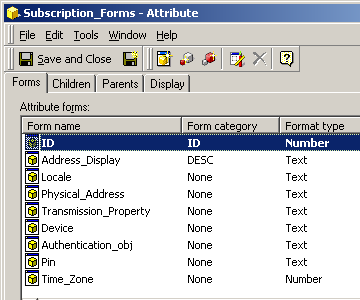
    • When using the definition of an information source object to retrieve dynamic subscription information, a single attribute can be created with forms mapping to each column containing subscription information:
ka04W000000Oe1EQAS_0EM440000002BoD.gif
  • Subscription Report
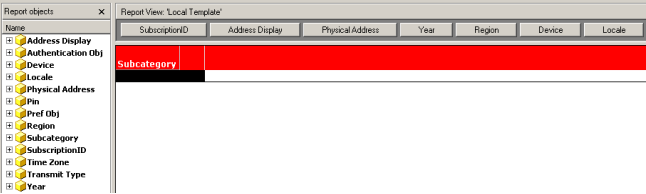
    • There must be one attribute corresponding to each column containing subscription information:
ka04W000000Oe1EQAS_0EM440000002BoP.gif
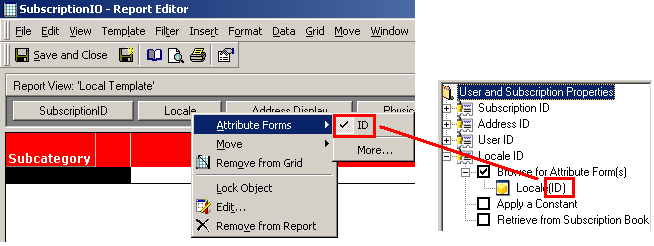
    • These attributes must be on the page-by axis of the subscription report.
    • The attribute returning subscription IDs must be the left-most attribute on the page-by axis:
ka04W000000Oe1EQAS_0EM440000002BoZ.gif
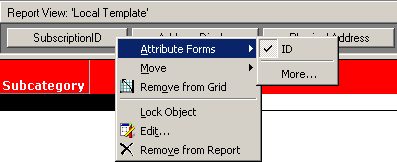
    • These attributes must display at most one attribute form:
ka04W000000Oe1EQAS_0EM440000002BoN.gif
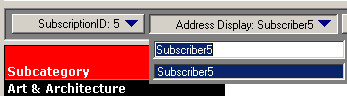
    • There must be a many-to-one relationship between the subscription ID attribute and the other attributes in the page-by section. That is, once a subscription ID is selected, the other attributes in the page-by must return at most one element:
ka04W000000Oe1EQAS_0EM440000002BoC.gif

The following requirements apply to content reports:
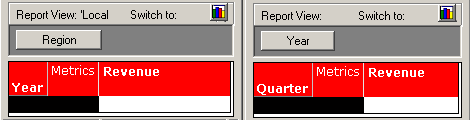
 

  • The slicing attribute must be the left-most attribute in the page-by axis of the report.
ka04W000000Oe1EQAS_0EM440000002BoY.gif
  • The subscription ID attribute must be used to slice content reports personalized by multiple attributes. The subscription ID attribute can be used as slicing attribute because there is a many-to-one relationship between it and the columns specifying the preference for Region and Year:
ka04W000000Oe1EQAS_0EM440000002BoI.gif

Narrowcast Server side
Information source, subscription information, and dynamic subscription set objects are unique to dynamic subscription services. All other Strategy Narrowcast objects (publications, documents, content information objects, question objects, and schedules) are configured the same way as in static subscription services.
 
It is critical that subscription information objects, content information objects, and question objects use the same information source object.
 
The following requirements apply to information sources:
  • When retrieving subscription information from a combination of Subscription Book Repository and an external data warehouse, the subscription IDs in the subscriptions table in the external data warehouse and in the Subscription Book Repository must be synchronized.
  • When retrieving subscription information from a report, the attribute forms referenced in the information source must match the attribute forms displayed in the subscription report:
ka04W000000Oe1EQAS_0EM440000002BoM.gif
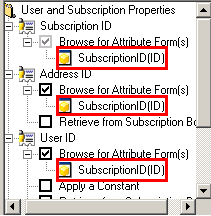
  • If subscription information will not be retrieved from the Subscription Book Repository, then the Address ID and User ID properties can use the same attribute form as the Subscription ID property:
ka04W000000Oe1EQAS_0EM440000002BoW.gif
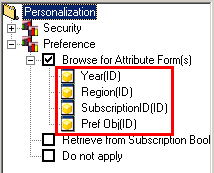
  • The Preference property must contain each attribute form that will be used to slice or personalize content reports:
ka04W000000Oe1EQAS_0EM440000002BoG.gif

The following requirements apply to subscription information objects:
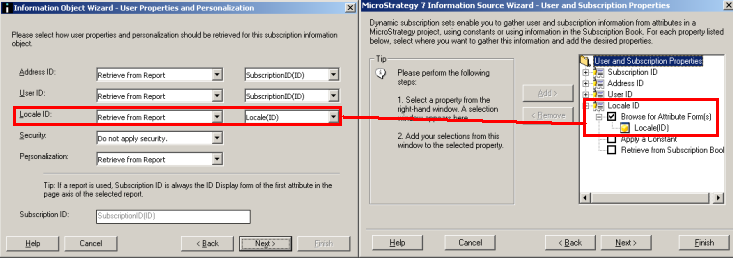
  • When retrieving subscription information from a report:
    • the information source used to connect to the subscription report must be the same information source used to create the content information objects in the service.
    • the attribute forms selected for each property must be among the attribute forms specified in the information source for the respective property. In the example below, the property Locale of the subscription information object uses an attribute form, Locale (ID), that appears among the attribute forms specified in the property Locale of the information source object.
ka04W000000Oe1EQAS_0EM440000002BoO.gif
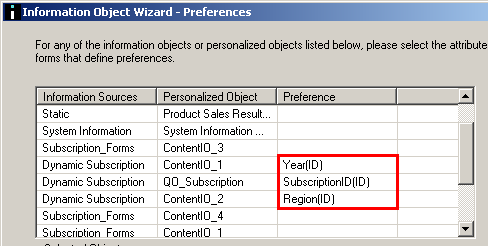
  • In the Preferences section, each personalized object (content information objects or question objects) contained in the service must be associated to one attribute form that defines the preference. In the example below, content information objects contentIO_1 and contentIO_2 are sliced by attributes Year and Region, respectively, and question object QO_Subscription prompts on attribute SubscriptionID:
ka04W000000Oe1EQAS_0EM440000002BoX.gif

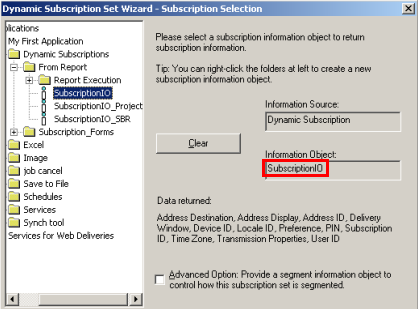
The only requirement for dynamic subscription sets is to point to the correct subscription information object for the service:
ka04W000000Oe1EQAS_0EM440000002BoE.gif


Comment

0 comments

Details

Knowledge Article

Published:

April 27, 2017

Last Updated:

April 27, 2017