For troubleshooting purposes, it is possible to record all API calls at the web transform layer. The transform layer is responsible for generating the HTML output so it could be useful to review this logging if there are problems with the final output.
To configure these diagnostics, load the Strategy Web Administration page and select the 'Configuration' link under the Diagnostics section.
Under 'Enable logging for multiple/other package(s)', specify the package (com.Strategy.web.transform), full name (filter on a specific user), pattern, and trace level, as shown below:
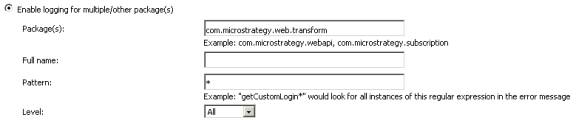
Once the information has been specified, save the changes. By default the logs are stored in the directory with a name similar to AdvMSTRLogweb_transform12345678_1.log.
It is also possible to use the custom diagnostics setup section if one wants to add specific logger or filtering parameters. To use this section, a file must be created. To achieve this, open Notepad and create a new file named 'logger-transform.properties' and paste the following contents to the file:
level=SEVERE
fileH.pattern=C\:/Program Files/MicroStrategy/Web ASPx/WEB-INF/log/MSTRLog%systemdate%.log
fileH.class=com.Strategy.utils.log.DatedFileHandler
consoleH.level=SEVERE
fileH.formatter=com.Strategy.web.app.XMLFormatterEx
handlers=consoleH,fileH
consoleH.formatter=com.Strategy.utils.log.ExtendedFormatter
fileH.level=ALL
consoleH.class=com.Strategy.utils.log.ConsoleHandler
# Web Objects
com.Strategy.web.transform.Log.AdvancedLoggerHandler.class=com.Strategy.utils.log.DatedFileHandler
com.Strategy.web.transform.Log.level=ALL
com.Strategy.web.transform.Log.AdvancedLoggerHandler.filter.trace=false
com.Strategy.web.transform.Log.AdvancedLoggerHandler.formatter=com.Strategy.web.app.XMLTracingFormatter
com.Strategy.web.transform.Log.AdvancedLoggerHandler.pattern=C\:/Program Files/MicroStrategy/Web ASPx/WEB-INF/log/WebTransform%systemdate%.log
com.Strategy.web.transform.Log.AdvancedLoggerHandler.level=ALL
com.Strategy.web.transform.Log.handlers=AdvancedLoggerHandler

NOTE: Tracing should be enabled for specific troubleshooting purposes. Do not to leave tracing enabled for extended periods of time because doing so will adversely affect performance.
