SYMPTOM:
A Strategy Narrowcast Server Administrator has a service which sends out hundreds of emails to subscribers. Along with this email, there is one Microsoft Excel attachment which is using a Personalized Page Execution, and there are subscribers which have the same preference (page-by) to be sent to them.
The Administrator then tests out this service and has the emails save to file by modifying the Information Transmitter, as shown below:

However, the Administrator notices that this week's test compared to last week's test is yielding a different number of emails and does not match the number of subscribers. However, the Administrator does not find any error messages in the DELog from the running of this service.
CAUSE:
The Strategy Execution Engine processes services in segments. These segments execute a subgroup of subscribers that are a subset of the full group of subscribers of the entire service.
Now, when the segment finds that an email that is going to be sent to one user (with a matching attachment if applicable) will also be sent to another user in the same segment, then the segment executor will send one email to both of the subscribers.
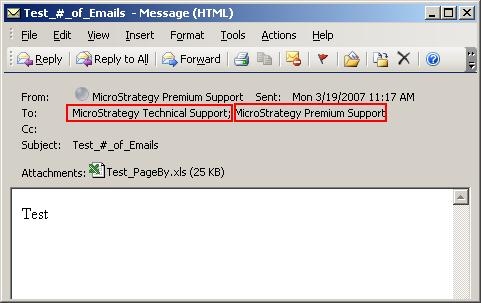
One important aspect of this functionality to keep in mind is the number of subscribers that will be processed per segment. This is controlled at the service level under Modify General Settings > Delivery Properties > Segment Size. For this above scenario to happen with one email being sent out to multiple subscribers, the subscribers with the same email being sent out to each other have to be processed within the same segment. When they are, then the email sent out to them will have both of the users in the To field as shown below:
If the service is setup with a dynamic subscription set and the segment size has not been modified, then one other thing that the administrator must keep in mind is the order in which the subscribers will be processed. The subscribers will be broken up per segment by the subscription ID of the subscriber. This is done is numeric order by the subscription engine.
For example, if a dynamic subscription set is composed of 100 subscribers with IDs 1 through 100 then if the segment size is set to 5, then even if subscribers with the IDs of 5 and 95 have the preference, they will not be processed together in the same segment. Two individual emails will be sent out, not one.
Therefore, when administrators are seeing a different number of emails being send out, the segment size, preferences, and subscription IDs need to be looked at to fully understand what is happening.
