The SQL (Structured Query Language) specification requires that, in any query that performs aggregation (that is, which includes a formula such as “sum(column)” or “avg(column)”), all expressions in the SELECT clause that do not perform aggregation, such as attribute IDs or descriptions, must appear in the GROUP BY clause.
Attribute ID form expressions will always appear in the group by clause, because this is necessary to define the aggregation level for the query. Attribute description forms can be rendered into SQL in two ways. Strategy's default technique is to write description form expressions into the SQL Max() function. Because this expression is being aggregated, there is no need to include that expression in the group by clause. By default, the SQL takes the following general form:
SELECT
 b.ATTR1_ID,
 MAX(b.ATTR1_DESC),
 SUM(a.Fact)
FROM
 BASE a,
 LOOKUP_ATTR1 b
GROUP BY
 b.ATTR1_ID
SELECT
 b.ATTR1_ID,
 b.ATTR1_DESC,
 SUM(a.Fact)
FROM
 BASE a,
 LOOKUP_ATTR1 b
GROUP BY
 b.ATTR1_ID,
 b.ATTR1_DESC
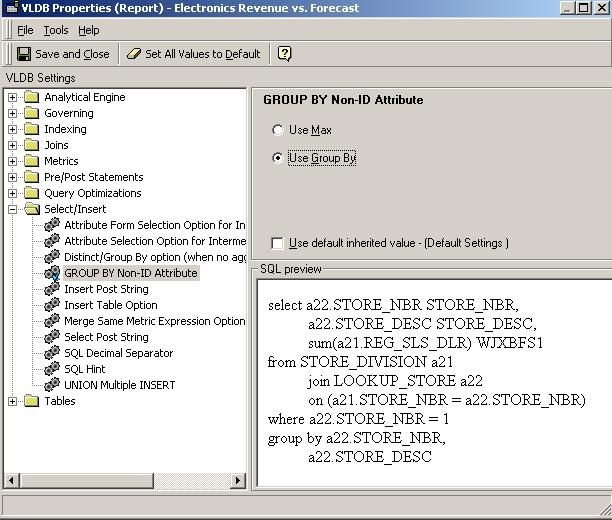
“Use Max” generates SQL in the first (default) form shown above. If the second form is desired, administrators may choose the second option for this VLDB property.
It is possible that some databases, in some environments, may evaluate Max() for attribute description forms noticeably more quickly or slowly than the corresponding SQL using group by for description forms. Such cases are rare and the circumstances that might cause a significant performance differential are not known.
