EducationSoftwareStrategy.com
StrategyCommunity

Knowledge Base

Product

Community

Knowledge Base

TopicsBrowse ArticlesDeveloper Zone

Product

Download SoftwareProduct DocumentationSecurity Hub

Education

Tutorial VideosSolution GalleryEducation courses

Community

GuidelinesGrandmastersEvents
x_social-icon_white.svglinkedin_social-icon_white.svg
Strategy logoCommunity

© Strategy Inc. All Rights Reserved.

LegalTerms of UsePrivacy Policy
  1. Home
  2. Topics

KB42057: How to Change the Font Formatting of a Report prior to Execution using the MicroStrategy Web SDK


Community Admin

• Strategy


Article outlines how Change the Font Formatting of a Report prior to Execution using the MicroStrategy Web SDK.

Strategy Web 9.3.0 offers the Format: Template window shown below out of the box, which permits users to choose the font, style, size, effect, and color of the text:
 

ka04W00000148pcQAA_0EM440000002Gea.png


The example provided in this document is provided “as-is” to the user and assumes that the user:

  • Can program, compile (e.g. javac, jikes, etc.), and execute Java programs
  • Can configure environment variables (e.g. JAR files, property files, etc.)
  • Have all the necessary tools to create Java applications (JDK, IDE, etc.)
  • Has access to the Strategy SDK documentation.
  • Has read the customization warning at the bottom of this document

PREREQUISITES:
 
For the sample to work, the Strategy Web JAR files must be accessible by the Java Runtime
Environment. The Strategy Web JAR files can be found under:

  • Strategy Web Universal (JSP): {web_root}/WEB-INF/lib directory.
  • Strategy Web (.NET): Program Files\Common Files\Strategy directory.

Note:
 
More elaborate programs will require additional library files and are out of the scope of this document.
 
Using the Web Customization Editor to create a plug-in
Strategy SDK provides a Web Customization Editor that can be used to create a customization plug-in. The following steps show how to create the plug-in and deploy.

  • Launch the Web Customization Editor.
     
  • Create a new plug-in and give it a meaningful name. For example: FormattingFont. (For step by step instructions on creating a new plug-in, please navigate to Home > Web SDK > Customizing Strategy Web > Web Customization Editor > Features and Customizable).
     
  • Click in Strategy Web Configuration inside the Application Settings view to expand the hierarchical tree. The expanded list comprises the different settings that can be modified to perform customizations.
     
  • Navigate to Pages. Right-mouse click report(Report Execution) and select Create New Add-On to launch the New Add-On Class Wizard.
     
  • Click Browse... next to the Source folder’s text field to select the src folder and click OK.
     
  • Enter the following information for the rest of the text fields:
    Package: ##Any package the client wants to use##
    Name: FormattingFont_AddOn
    Add-on description: This add-on will modify the font format before the report displays for the user.
    Check the box for “Add custom logic after fetching data from Intelligence Server (postCollectData)"
     
ka04W00000148pcQAA_0EM440000002GeU.png
  • Click Finish. The FormattingFont_AddOn_AddOn.java file should open in Eclipse. For additional information on Add-On creation, reference the MSDZ (Home > Web SDK > Customizing Strategy Web > Part II: Advanced Customization Topics > Customizing Add-ons> Add-on Creation).
     
  • Modify the preCollectData method as follows:
     
        public void preCollectData(PageComponent page) {
     
         ReportBean rb = getReportBean(page);
      if (rb!=null) {
       try{
              /*
               * Steps taken to change formatting
               * 1) Set the execution flag to DssXmlExecutionResolve to retrieve template
               * 2) CollectData
               * 3) Continue if pollStatus is DssXmlStatusResult
               * 4) Go through each metric's WebFormatContainer
               * 5) For each metric, do steps 6 and 7
               * 6)   setDefaultForProperty for each FormattingFont property
               * 7)   setFormatProperty for each FormattingFont property.
               * 8) Set setExecutionFlags to ~DssXmlExecutionResolve to continue with normal execution
               * 9) Instruct the report manipulator to applyChanges
              */
        
               rb.getReportInstance().setAsync(false);
               rb.getReportInstance().setPollingFrequency(250);
               rb.getReportInstance().setMaxWait(120000);
               rb.setExecutionFlags(EnumDSSXMLExecutionFlags.DssXmlExecutionResolve);
               rb.collectData();
               
            int status = rb.getReportInstance().pollStatus();
            if (status == EnumDSSXMLStatus.DssXmlStatusResult) {
             
                   Enumeration metrics = rb.getReportInstance().getTemplate().getTemplateMetrics().elements();
                   while(metrics.hasMoreElements()) {
                    WebTemplateMetric metric = (WebTemplateMetric) metrics.nextElement();
                    WebFormatContainer container = metric.getFormatContainer();
                    
                    
                    container.setDefaultForProperty(EnumWebFormatType.WebFormatTypeGrid, "FormattingFont", "Name", true);
                    container.setFormatProperty(EnumWebFormatType.WebFormatTypeGrid, "FormattingFont", "Name","Arial", false);
                    
                    container.setDefaultForProperty(EnumWebFormatType.WebFormatTypeGrid, "FormattingFont", "Size", true);
                    container.setFormatProperty(EnumWebFormatType.WebFormatTypeGrid, "FormattingFont", "Size","12", false);
                    
                    /* -1 to enable, 0 to disable */
                    container.setDefaultForProperty(EnumWebFormatType.WebFormatTypeGrid, "FormattingFont", "Bold", true);
                    container.setFormatProperty(EnumWebFormatType.WebFormatTypeGrid, "FormattingFont", "Bold","-1", false);
                    /* -1 to enable, 0 to disable */
                    container.setDefaultForProperty(EnumWebFormatType.WebFormatTypeGrid, "FormattingFont", "Italic", true);
                    container.setFormatProperty(EnumWebFormatType.WebFormatTypeGrid, "FormattingFont", "Italic","0", false);
                    /* The BBGGRR decimal representation of the color.  Example: Red ->  0 0 255 */
                    container.setDefaultForProperty(EnumWebFormatType.WebFormatTypeGrid, "FormattingFont", "Color", true);
                    container.setFormatProperty(EnumWebFormatType.WebFormatTypeGrid, "FormattingFont", "Color","00255", false);
                    /* -1 to enable, 0 to disable */
                    container.setDefaultForProperty(EnumWebFormatType.WebFormatTypeGrid, "FormattingFont", "Strikeout", true);
                    container.setFormatProperty(EnumWebFormatType.WebFormatTypeGrid, "FormattingFont", "Strikeout","-1", false);
                    /* -1 to enable, 0 to disable */
                    container.setDefaultForProperty(EnumWebFormatType.WebFormatTypeGrid, "FormattingFont", "Underline", true);
                    container.setFormatProperty(EnumWebFormatType.WebFormatTypeGrid, "FormattingFont", "Underline","-1", false);
                   }
            }
            rb.setExecutionFlags(~EnumDSSXMLExecutionFlags.DssXmlExecutionResolve);
            rb.getReportInstance().getReportManipulator().applyChanges();
            }catch(Exception e){
             e.printStackTrace();
            }
      }
     }
     
    /*
     * ************************PRIVATE METHODS************************
     */
     
     //Checks whether a web component is a report bean and returns that
     //bean if found, returning null otherwise.
     private static ReportBean getReportBean(WebComponent wc) {
      ReportBean result = null;
      //if the current web component is a ReportBean then return it
      if (wc instanceof ReportBean) {
       result = (ReportBean) wc;
      //otherwise, try to find a report bean amongst the page children
      } else {
       for (int i = 0; i < wc.getChildCount(); i++) {
        //search recursively through all children
        result = getReportBean(wc.getChild(i));
        if (result != null) break;
       }
      }
      return result;
     }
     
  • Save the changes.
     
  • Double-click report(Report Execution) to open the editor.
     
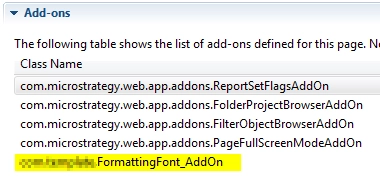
  • Click on the Add-on Properties tab. On the Add-On Properties tab, the custom add-on class FormattingFont_AddOn, should be listed under Class Name: 
     
ka04W00000148pcQAA_0EM440000002Gec.png
  •  Restart the Web Server to see the changes applied in Web.

ADDITIONAL INFORMATION:
 
The Strategy SDK allows you to customize the standard Strategy Web interface, and extend and integrate the Strategy business intelligence functionality into other applications. However, before changing the way Strategy Web products look or behave, it is helpful to understand how the application is built. For more information regarding the Strategy Web architecture or the process of customizing Strategy Web, please refer to Strategy Developer Zone (https://community.strategy.com/topic/0TO44000000FliLGAS/sdk).
 
CUSTOMIZATION WARNING:
 
This customization is provided as a convenience to Strategy users and is only directly applicable to the version stated. While this code may apply to other releases directly, Strategy Technical Support makes no guarantees that the code provided will apply to any future or previous builds. In the event of a code change in future builds, Strategy Technical Support makes no guarantee that an updated version of this particular customization will be provided. In the event of a code change in future builds, Strategy may not be able to provide additional code on this matter even though this customization is provided at this time for this specific build. For enhancements to this customization or to incorporate similar functionality into other versions, contact your Account Executive to inquire about Strategy Consulting assistance.


Comment

0 comments

Details

Knowledge Article

Published:

June 8, 2017

Last Updated:

June 8, 2017