EducationSoftwareStrategy.com
StrategyCommunity

Knowledge Base

Product

Community

Knowledge Base

TopicsBrowse ArticlesDeveloper Zone

Product

Download SoftwareProduct DocumentationSecurity Hub

Education

Tutorial VideosSolution GalleryEducation courses

Community

GuidelinesGrandmastersEvents
x_social-icon_white.svglinkedin_social-icon_white.svg
Strategy logoCommunity

© Strategy Inc. All Rights Reserved.

LegalTerms of UsePrivacy Policy
  1. Home
  2. Topics

KB9392: How to use Dimensionality with Compound Metrics in MicroStrategy Developer (formerly Desktop)


Stefan Zepeda

Salesforce Solutions Architect • Strategy


This article outlines how to use Dimensionality with Compound Metrics in MicroStrategy Developer

Strategy Developer (formerly Desktop) does not allow for dimensionality in compound metrics. However, this document demonstrates how to set dimensionality to compound metrics by creating another metric that is (technically) not defined as a compound metric. In this way, users can set dimensionality to compound metrics.
 
To achieve this, perform the following steps:
 

  • Create a metric called "Profit".
  • Create a metric called "Revenue".
  • Create a compound metric that is defined as Profit + Revenue and name it "Profit + Revenue Compound Metric".
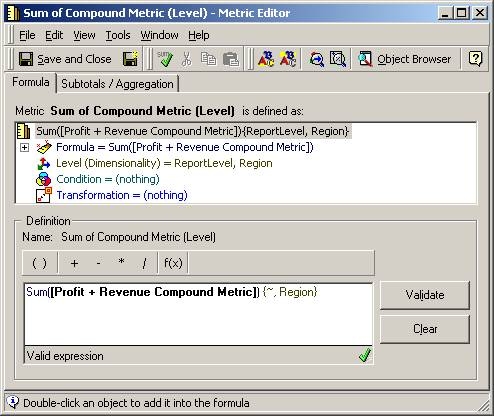
  • Create a new metric that is defined as the sum of "Profit + Revenue Compound Metric" with the dimensionality set to the "Region", as shown in the figure below:
ka02R000000kYCAQA2_0EM440000002G1J.jpeg
  •  
    Sum(){~,Region}
  • This metric will serve as the workaround for setting dimensionality to compound metrics.
     
  • Save the new metric as "Sum of Compound Metric (Level)".
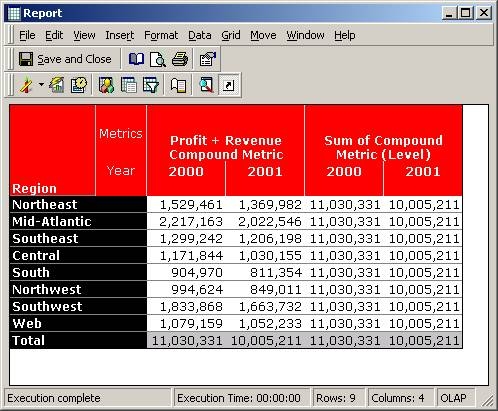
  • Create a report that makes use of the metric created in Step #4, as shown in the following screen shot:
ka02R000000kYCAQA2_0EM440000002G1L.jpeg

Comment

0 comments

Details

Knowledge Article

Published:

June 9, 2017

Last Updated:

June 9, 2017