Attribute forms are intended as an alternate description for an attribute. Attributes related in a hierarchy generally allow more flexible data modeling.
Normally, it is preferable to use separate attributes that are related hierarchically (that is, parent-child relationships) for the following reasons:
If these data modeling features are not required for a particular relationship, then an attribute form can legitimately be used. For example, a customer or employee attribute may have separate forms for ID, full name, first name, and last name. Since one will typically be reporting on customers or employees, there's no need to have separate attributes for each of these forms.
However, if it's desired to aggregate at the level of last name, for instance, then a separate attribute will be required. If a user creates a report in the Strategy Tutorial project displaying 'Customer' (Last Name form only) and 'Revenue', and filtering on Last Name Begins with "Sm," the report will show the following results:
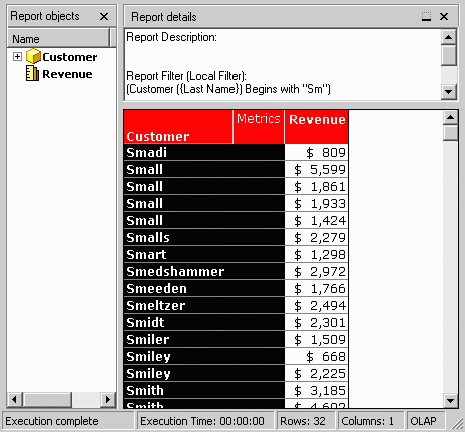
Note that the results are not aggregated at the level of the customer's last name, but rather at the level of Customer. If the report level were Customer Last Name, there would be only one entry for each distinct last name. If it is desired to create a report showing total revenue for distinct last names, Customer Last Name must exist as its own attribute.
If an attribute's lookup table contains numerous columns of descriptive information, such as first name, last name, zip code, income bracket, etc., users may think it is logical to view all of these as forms of the attribute since they come from the same table. As demonstrated above, however, this imposes serious constraints on the ability to create reports at multiple dimensions.
Users should always be careful with attributes containing more than four or five forms. If many or most attributes in a schema have large numbers of forms, it is an indicator that several aspects of the schema design may need to be reconsidered.
Attribute forms are not appropriate under the following circumstances:
Attribute forms are appropriate when the following is true:
