Starting with the release of Strategy ONE (March 2024), dossiers are also known as dashboards.

The engine to successful Strategy adoption is being able to deliver work product to the end-user community in an accurate and timely fashion. Typically, BI delivery teams are working to provide metrics and analytics to other departments to help improve performance and communication, but in many instances this is a case of “the shoemakers children have no shoes.” Business Intelligence is developed for other business areas, but not for the BI delivery teams themselves.
This is not to say that the teams are doing a poor job in their delivery, but the purpose of Business Intelligence is to find ways to improve. With business demands to have quicker turn-around, while ensuring accuracy, it is incumbent upon the delivery teams to continually improve.
Current
In many organizations, the current state typically consists of a set of tasks and whether or not the team is meeting the deadlines. This applies in both methods of waterfall and Agile Scrum methods. A team can say they can deliver a certain medium-complexity dashboard in two-months. But there is no empirical evidence to support that, since historically the data has been chunked into stories, or not categorized and tracked through the process.
Better BI Delivery
What are some of the questions that could be asked by applying BI to BI?
Even when teams are using a project management tool, they are still using the limited built-in reporting or dumping to Excel for further analysis. Effectively going counter to the very principles that are being promoted to other areas of the organization.
BI on BI Framework
Following the same process for all areas, teams should be leveraging a project management application that can effectively track the tasks. Examples of these with connectors to Strategy are:
Like most applications, the effectiveness comes in correctly setting the application up for your usage. For example, in JIRA, the default configuration comes as a Task. A Task has a status of To-Do, Doing, or Done. This effectively lumps everything into a single category. Whereas some of our processes for end-to-end BI Delivery includes functions as processes such as:
Though embedded within each of the processes are steps inherent to that process, such as for Requirements Gathering\Definition would have both a business and a technical review step included, or Dossier would have Peer Review, UAT, and deployment steps on its way to ultimately being deployed to the end-user.
By defining your processes and the steps within those, it allows you to ensure adequate time was spent at appropriate steps to mitigate risk or identify bottlenecks and areas of improvement. Being able to compare apples-to-apples begins to allow true benchmarking for overall delivery improvement. For example, being able to identify that the average end-to-end for a medium-complexity dashboard was normally 72 days, down to 65 days 3 quarters later, and down to 42 days another 3 quarters later.
Further baselining also helps to identify work streams that are falling behind, rather than compiling status reports for everything that is communicated in a document or an email. It can be distributed to various stakeholders that are already using Strategy analytics through exception reports, or their own Dossiers and Dashboards that provide a holistic view of the information they need.
Key Metrics
The goal of identifying key metrics is to find areas of improvement and provide visibility to the entire organization. Often times, while the end consumer may say that it takes a long time to deliver, it may be the end consumer that hinders the process. Alternatively, being able to understand the impact of constantly shifting priorities and being able to back that with empirical data. For BI and Analytics teams to use BI, it helps provide backing to highlight different impediments within the organization.
Keys to Elements of Success
Define your processes: Define your processes with the end-to-end steps that define finished. Include every step where an ownership element exists.
Example Requirements & Design
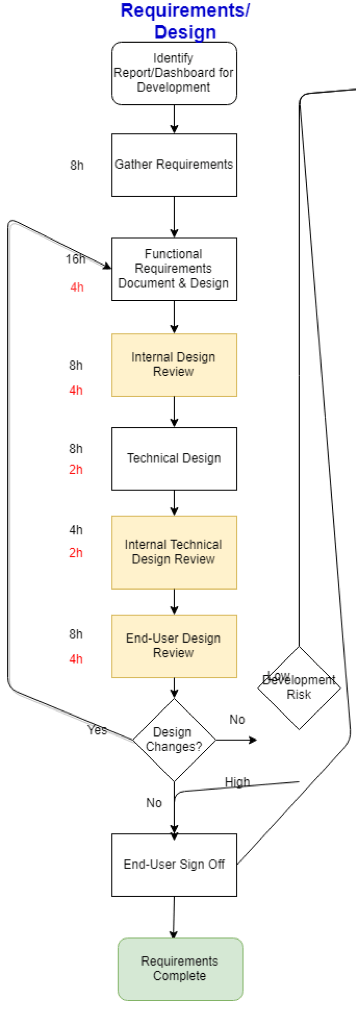
Development Style Workflow
(ETL, Schema Objects, Report, Dossier)

Track by Process: Ensure that apples-to-apples comparisons can be done. Track database development components separate from reports; track by new development verses enhancements.
https://codice.atlassian.net/secure/ShowConstantsHelp.jspa?decorator=popup#IssueTypes
Track Ownership: When the primary ownership of a given step of the process is complete, it should move from that person’s plate to the next person. This allows managers to see who actually has work, and is currently responsible, as well as defining areas to improve within the process.
Adapt Project Management for You: Many organizations have embraced Agile Scrum which consists of sprints over x period of days/weeks. Unfortunately, many processes don’t complete within that time. This has become a one-size fits all approach that limits analytics where many things can be put into a process. From a Project Manager perspective this may require a sort of double-entry. Manage your processes to be able to track end-to-end, while then segmenting those to your Sprint goals for your organization.
Successfully leveraging Strategy Business Intelligence on your Business Intelligence delivery, you can effectively provide continuous improvement, justification of purpose and budget, decrease risk, and improve communication. This ultimately drives success in all other areas of your organization that leverages the insights that your teams deliver.
Ryan Forsythe
AllScient
www.AllScient.com
Ryan has delivered Business Intelligence and Analytics consulting to over 50 companies and organizations. He is a Strategy Certified Master Analyst (MCMA) and Strategy Community Master. He graduated from Boston College with a degree in Business and concentrations in Finance and Computer Science.
A note from the Community team
Want some dossier design best practices? Check out this article.
