Starting with the release of Strategy ONE (March 2024), dossiers are also known as dashboards.
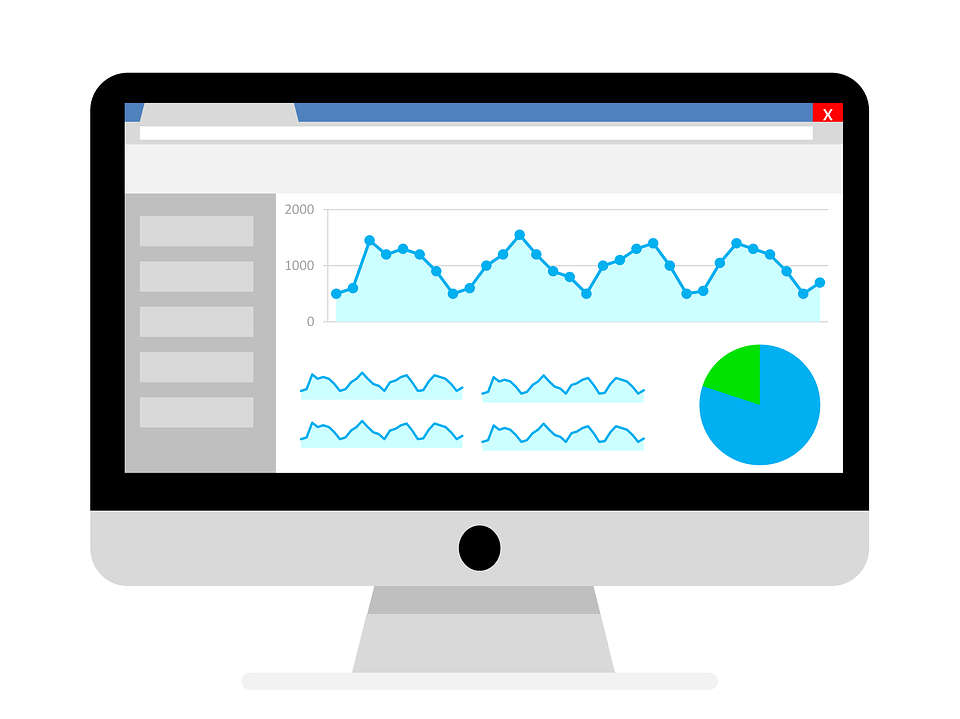
Source: https://pixabay.com/illustrations/analytics-google-analytics-1925495/
Regardless of their industry or scope, most organizations should strive to acquire as many performance insights as possible. Whether they identify themselves as data-driven or not, performance data allows for actionable insights that can improve decision-making. The analytics industry stresses this strongly as well, prioritizing actionable data. The data extraction and analysis process present a point of frequent terminological confusion; Business Intelligence vs. Data Analytics.
In part because of colloquial connotations and in part because the two overlap, these two terms often see interchangeable use. However, they're not quite the same as we'll explain in this article.
Superficially, both of these terms would refer to data collection and processing. Both “intelligence” and “data analysis” should suggest something similar in this sense, colloquially. Their applications may also push this understanding further. Organizations use both toward virtually the same goal, and both improve decision-making, so some overlap exists.
Still, the two are distinctly different, despite sharing some common ground. As a safe starting point toward illustrating this, we may begin with more solid definitions.
Investopedia defines Business Intelligence (BI) as follows:
“Business intelligence (BI) refers to the procedural and technical infrastructure that collects, stores, and analyzes the data produced by a company’s activities.[…] BI parses all the data generated by a business and presents easy-to-digest reports, performance measures, and trends that inform management decisions.”
TechTarget’s definition of BI also echoes the above, as it illustrates BI’s procedural nature:
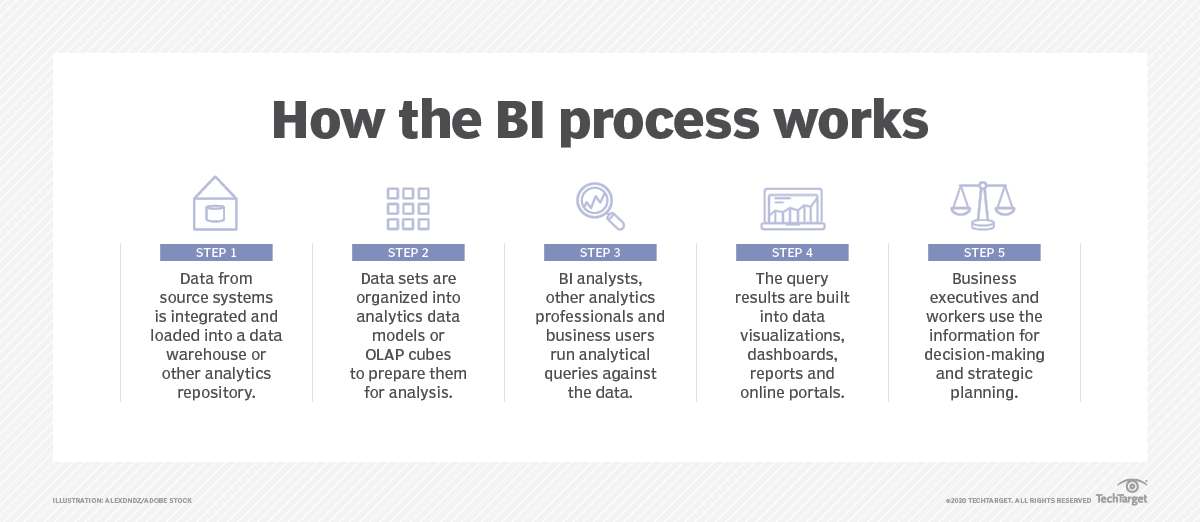
Source: https://cdn.ttgtmedia.com/rms/onlineImages/business_analytics-how_the_bi_process_works-f.png
Page source: https://www.techtarget.com/searchbusinessanalytics/definition/business-intelligence-BI
This should hopefully serve as a solid initial definition. However, Investopedia’s omitted part can partially explain the confusion between the terms:
“BI is a broad term that encompasses data mining, process analysis, performance benchmarking, and descriptive analytics.”
The root of confusion here is thus twofold. One, BI is a broad term by nature, adjacent to data analytics. And two, it includes descriptive analytics, one of the four primary types of data analytics. This may very well be why the Business Intelligence vs. Data Analytics debate persists.
In contrast, Investopedia defines Data Analytics (DA) as follows:
“Data analytics is the science of analyzing raw data to make conclusions about that information. […] Data analytics is a broad term that encompasses many diverse types of data analysis.”
To remain consistent with our sources, TechTarget’s definition of DA largely agrees:
“Data analytics is primarily an umbrella term[.] [It] is the process of examining data sets in order to find trends and draw conclusions[.]”
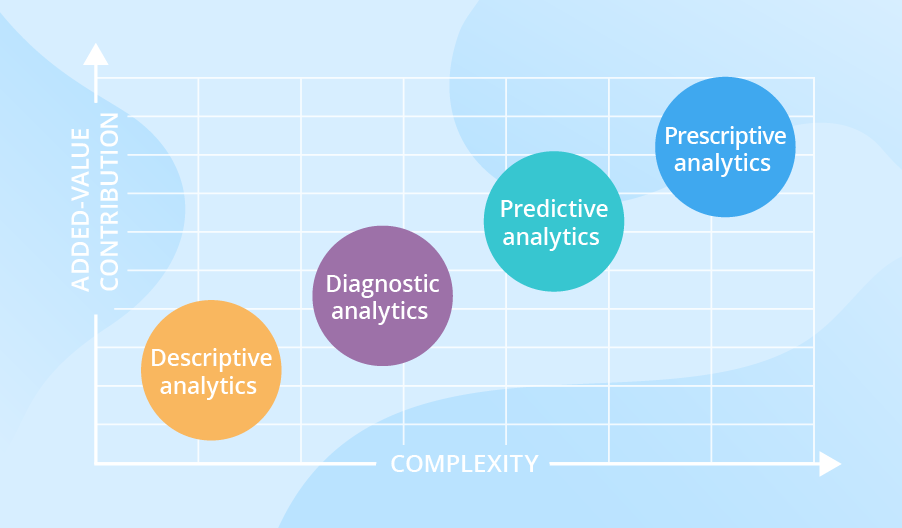
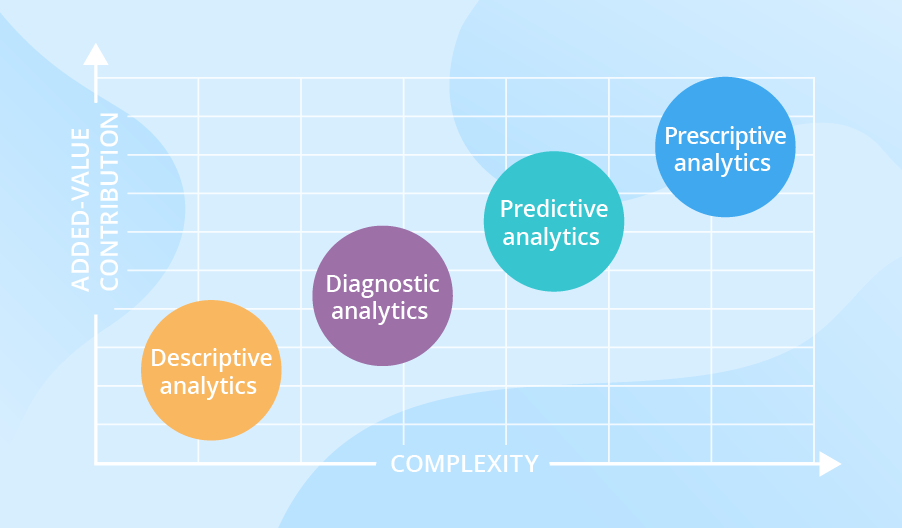
Here, too, one can argue the confusion emerges from two key factors; term broadness and shared descriptive analytics. The latter bears noting, as Data Analytics primarily consists of four main types of analytics:
ScienceSoft illustrates the scaling complexity of these four types as follows:
Source: https://www.scnsoft.com/blog-pictures/business-intelligence/4-types-of-data-analytics.png
Page source: https://www.scnsoft.com/blog/4-types-of-data-analytics
With definitions in order and having pinpointed where their overlaps occur, we can identify their explicit differences. In doing so, we may begin to untangle the two terms.
First, the two have rather different times of interest. Of course, how much the two overlap in action will strengthen or weaken this distinction between the two.
BI primarily delves into past data, seeking to inform future directions. Instead, DA delves into past, present, and future, pinpointing past trends and forecasting future ones alike. The primary example of this lies in predictive analytics, making DA far more future-minded.
A second difference between the two lies in the types of data they use: structured and unstructured.
DA primarily seeks to collect unstructured, real-time data before processing and cleaning it up. For example, website analytics like those of WP Full Care and other service providers will primarily collect raw field data. Said data will then require processing and storage before fueling digestible reports. In contrast, BI primarily uses structured data, typically produced by DA, to let users craft said reports.
An adjacent difference to the above, the two also differ regarding insight acquisition and use. For many, this should serve as the primary distinguishing factor in the Business Intelligence vs. Data Analytics debate.
In brief, DA primarily collects and creates insights. It collects and processes data into an actionable form but does not inherently use it beyond prescriptive analytics. In contrast, BI seeks to use DA's insights to inform decision-making, often through data storytelling and other practices.
Following the above, the two present another inherent difference; their scope of interest.
DA focuses on an individual issue, occurrence, or question of interest. It may explore a particular product's or service's past performance, for example, or forecast its future one. Conversely, BI uses all DA insights to explore broader subjects, such as an organization's overall direction.
Finally, in summarizing the above in a sense, the two also have a difference regarding user expertise. While arguably not as crucial as the above, this too likely bears noting.
DA typically requires technical expertise; it is the job of analysts and data scientists who firmly grasp the field. Instead, BI may be used by non-technical staff or personnel, such as leadership teams. Between the subject matters and intended roles of the two, their differences culminate into this one; who uses each.
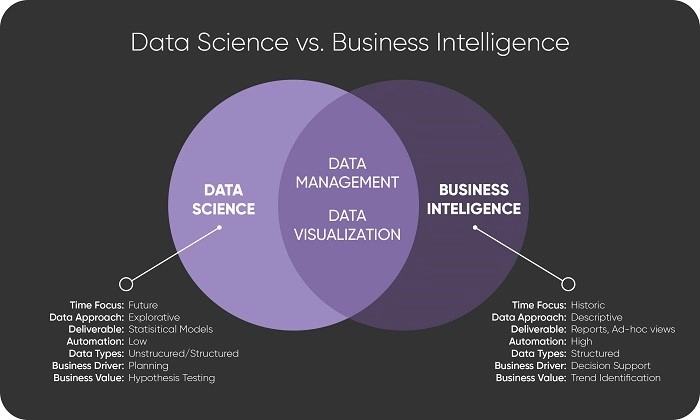
Before concluding, we may briefly also note that the two do share ample common ground. This has hopefully become apparent so far, but Pugsley’s following illustration should help cement this point:
Source: https://blog.tdwi.eu/wp-content/uploads/2019/12/TDWI_Blog_BusinessIntelligence_DataScience_Data_Insights_1.jpg
Page source: https://blog.tdwi.eu/data-science-business-intelligence-and-analytics-analyzing-differences-and-similarities-with-python/
Indeed, despite their distinct differences, the two also overlap in some key regards:
Still, this common ground should not fuel confusion between the two terms. The two should be understood as synergistic, and one should acknowledge their overlap in goals and function. However, for the sake of clarity and accuracy, the two should remain distinct and separate terms.
To summarize, BI and DA do overlap in notable ways. Where DA collects and processes data, BI leverages it. They both delve into an organization's performance and seek to inform decision-making.
However, they also differ in time focus, scope, data, insights use, and even intended user. BI will include DA, but the two remain distinct parts of a larger whole. Analyzing Business Intelligence vs. Data Analytics side by side, we hope the two terms are now clear – and more distinct.